
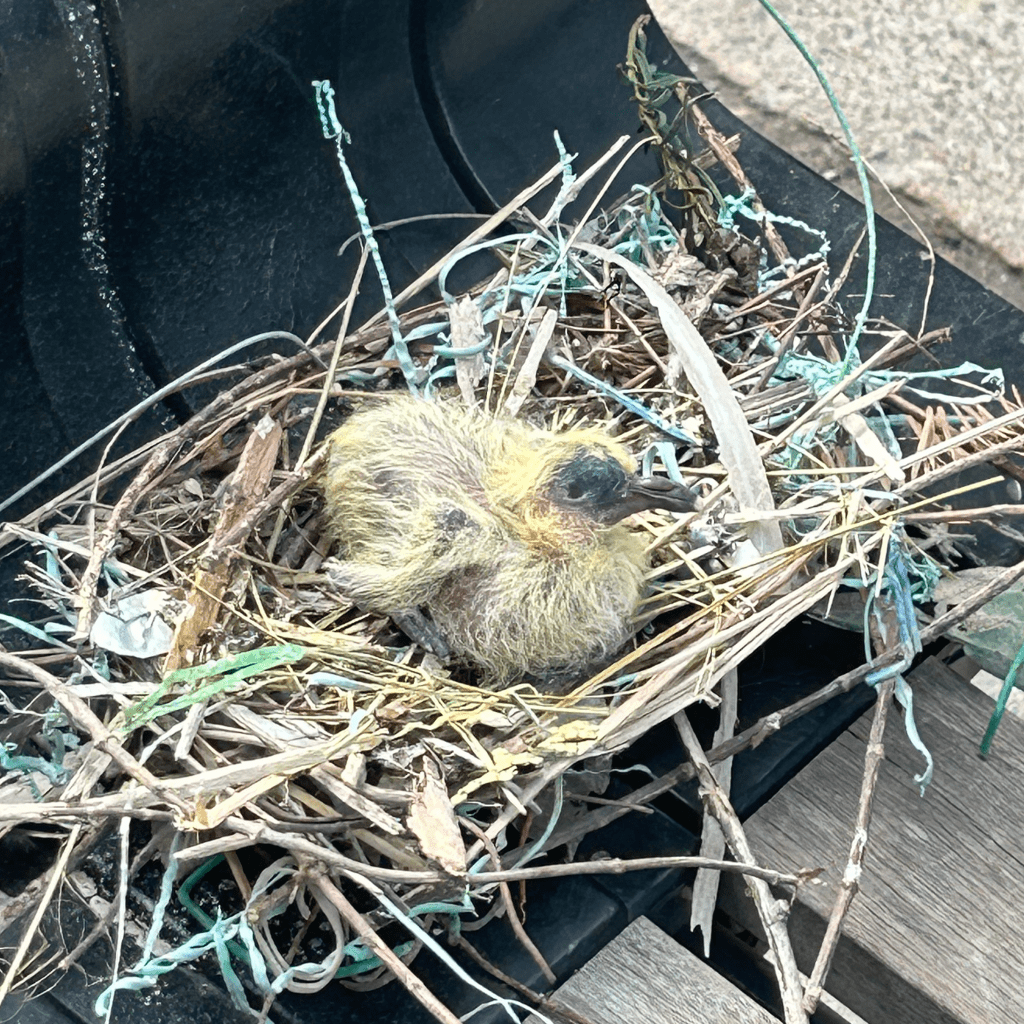
It is October in the city. Every week crawls a little closer to winter, a litter further from fall. There is little more darkness around the edges of the day, a little more bite in the cold of the night. I am walking from my grey doorstep to the grey subway station when I see a funny little grey bird nearly blending in with the pavement – a baby pigeon. I know it instantly from a Google search. A rare, juvenile version of a common bird.
I remember a conversation trending on Tiktok months ago: have you ever seen a baby pigeon? The general consensus was, no, the pigeons keep a tight leash on their young. Cluttering sidewalks and benches and lampposts across the city seems to be somewhat of a coming of age rite of passage in pigeon culture. While they vary in colour and design, the average pigeon is exactly the same size as the one beside it. Where are the itty bitty baby pigeons? Where are the pigeon nests and roosting pigeon mothers?
The truth is that feral pigeons are the descendants of domesticated rock doves – a species whose cliffside dwellings made hidden, weather-protected nests a crucial factor of survival. This trait has continued to serve pigeons well in an urban environment that treats them as pests and constructs hostile architecture to discourage their existence. It’s no accident that pigeon nests are very hard to find. On top of this, a mother pigeons lays only one to two eggs at a time and both mother and father pigeon work together to care for their young for an entire month – more than twice as long as other similar species of bird. By the time the little birds leave the nest they are full grown young adults and bare no more markings of their youth and innocence.1
The Internet’s answer to this question of pigeon origin is, perhaps, more entertaining than the truth. According to teenage Tiktok comedians, the apparent lack of pigeon reproduction is proof of a conspiracy about high level government surveillance. The government is watching us; the pigeons aren’t real. There is an FBI agent in your phone and robotic technology is way more advanced than the New York Times is letting on. Each little bird is not a bird but, in fact, a robot programmed to traverse the land and sky in attempt to provide bureaucratic bigwigs with a constant feed of information about when you left your house to go to the grocery story and who you ran into at the crosswalk on the way there.
Maybe I’m a romantic, but I prefer the sweet little nuclear pigeon family narrative over the robot bird drone version. Maybe this is the reason that I am given this gift from the universe – this funny grey bird with awkward yellow bits of baby fluff sticking out at odd ends all around its head and neck. Its round black eye and delicate, pinkish beak watching and tasting the world for what I am imaging is close to the very first time. No one walking by this street corner seems to notice or care, but I am someone who admires pigeons often. I am immediately pulling out my phone to take a video of this unicorn-like creature. I am late to work because of this.
At work, I pull my phone out before I take my jacket off. I am immediately showing it to Gunes. I am saying, “have you ever even seen a baby pigeon before? Isn’t it incredible?” Gunes is not having the best of days.
“Pigeons are pests,” he says. “They shit everywhere. They’re vermin. They carry diseases.” I roll my eyes and point to the poster on the wall of a play I wrote for a festival last summer featuring a chorus of pigeons. The poster has a cartoonish drawing of a girl wearing a hat shaped like a pigeon in the centre. I drew the cartoon myself. I am often asked if the girl is me (I’d like to think my imagination is a little better than that).
“I take that personally.”
“Of course you do.”
When Alex comes in to start his shift I take the video out again. Alex is the sort of eternally positive, sprite-like creature who makes you believe in fairies and love potions and communism. Even still, his response to the baby pigeon is,
“Oh! Would you look at that.” I launch into an unedited version of this post during which his eyes glaze over and over and over again. No matter what I do, I can’t make it clear to my coworkers that what I’ve seen is a wondrous, precious thing. That it’s ominous, too. I can’t help but question what circumstances led such a young pigeon to be roaming the streets of Toronto, so much sooner than his peers. Something has made him grow up a bit too fast. It isn’t lost on me that this special moment for me might be one of extreme tragedy for the little pigeon.
It’s lost on my coworkers, though. We all work in theatre and yet somehow I am always the most dramatic. Something I have learned from being dramatic is that joy, in it’s many unique forms, is always either amplified or diminished through the process of communication. There are joys that are meant to be shared and joys that are meant to be held secret. I am still figuring out how to identify which is which before opening my big mouth.
1 Everything I know about pigeons comes from Wikipedia, The Thing With Feathers by Noah Strycker, and Unseen City: The Majesty of Pigeons, the Discreet Charm of Sails & Other Wonders of the Urban Wilderness by Nathanael Johnson. Both are great books that I would recommend to anyone interested in birds or urban ecology, respectively!
 all my marbles
Leave a comment